What are the risks of Radon gas ?
Accueil » What are the risks of Radon gas ?
What is Radon gas ?
Naturally occurring Radon is produced by the radioactive decay of radium present in rocks and soils. This radioactive gas forms solid daughter products, which are themselves radioactive, as it decays. Once inhaled, they attach to the respiratory tract and cause irradiation.
The activity concentration, or more commonly known as the concentration of Radon is expressed in Bq/m³ (Becquerels per cubic meter). In outdoor air, Radon dilutes rapidly, and its average concentration generally remains low: most often less than ten Bq/m³. In confined spaces such as caves, underground mines, but also buildings in general, and homes in particular, it can accumulate and reach high concentrations, sometimes reaching several thousand Bq/m³.
How Radon Infiltrates and Accumulates in a Home
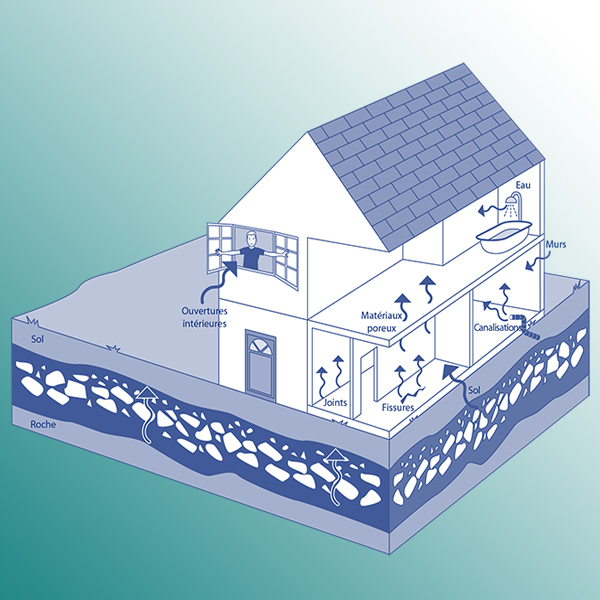
There are many ways Radon can enter a home. The main source of entry into a house is the basement. Radon gas tends to accumulate in unventilated or poorly ventilated areas, such as basements, or in newer homes, crawl spaces.
In basements, Radon can seep through cracks and pores and then concentrate in cellars, basements, and other poorly sealed rooms. Radon can also come from the building materials used or from water.
The concentration of Radon inside your home will depend on the geological nature of your basement, the structure of your home, and the ventilation rate. The more granite or schist the soil, the higher the Radon potential, unlike in sedimentary soils. Radon concentration can vary from one house to another due to the construction type and the lifestyle of the occupants (ventilation, number of residents or occupants).
The consequences of exposure to Radon on human health
Radon 222 gas, as a noble gas, is not directly radiotoxic, but its short-lived solid descendants, such as Polonium 218 and Polonium 214, bind to atmospheric aerosols. Once inhaled, they can settle on the pulmonary mucous membranes and, due to their energy, become potential sources of cancer. Radon gas and its daughter products can penetrate the lungs. Their decay there emits alpha particles that damage lung cells. These damaged cells reproduce and can then cause cancer.
No immediate health effects have been demonstrated, and it is indeed long-term exposure that increases the risk of cancer. Unfortunately, because this gas is odorless and colorless, and causes no immediate health effects, too few people are aware of the existence of Radon. The results of numerous epidemiological studies conducted in recent years are consistent and show that this risk is proportional to Radon exposure and that it is significant for continuous domestic exposures over thirty years from Radon concentrations above approximately 200 Bq/m³. It is therefore “riskier” to spend one’s life in a house with an average concentration than to spend a few hours in a building where the level is very high. For the same exposure to Radon, the risk of developing lung cancer is significantly higher for a smoker than for a non-smoker: approximately 20 times higher for the same Radon exposure. Radon has been classified by the French National Cancer Research Center as a lung carcinogen since 1987.
Radon concentration inside your home will depend on the geological nature of your basement, the structure of your home, and the ventilation rate. The more granite or schist the soil, the higher the Radon potential, unlike sedimentary soils. Radon concentration can vary from one house to another due to the construction type and the lifestyle of the occupants (ventilation, number of residents or occupants).
Am I at risk of Radon?
Radon is present in many departments in France due to their geology. These regions are located on large granite massifs such as the Massif Central, the Vosges, the Armorican Massif, Corsica, etc. Other French regions are not exempt from Radon, however : this natural gas is present everywhere.
To find out the Radon potential of your municipality, visit the website Autorité de Sûreté Nuclaire et de Radioprotection (ASNR).